
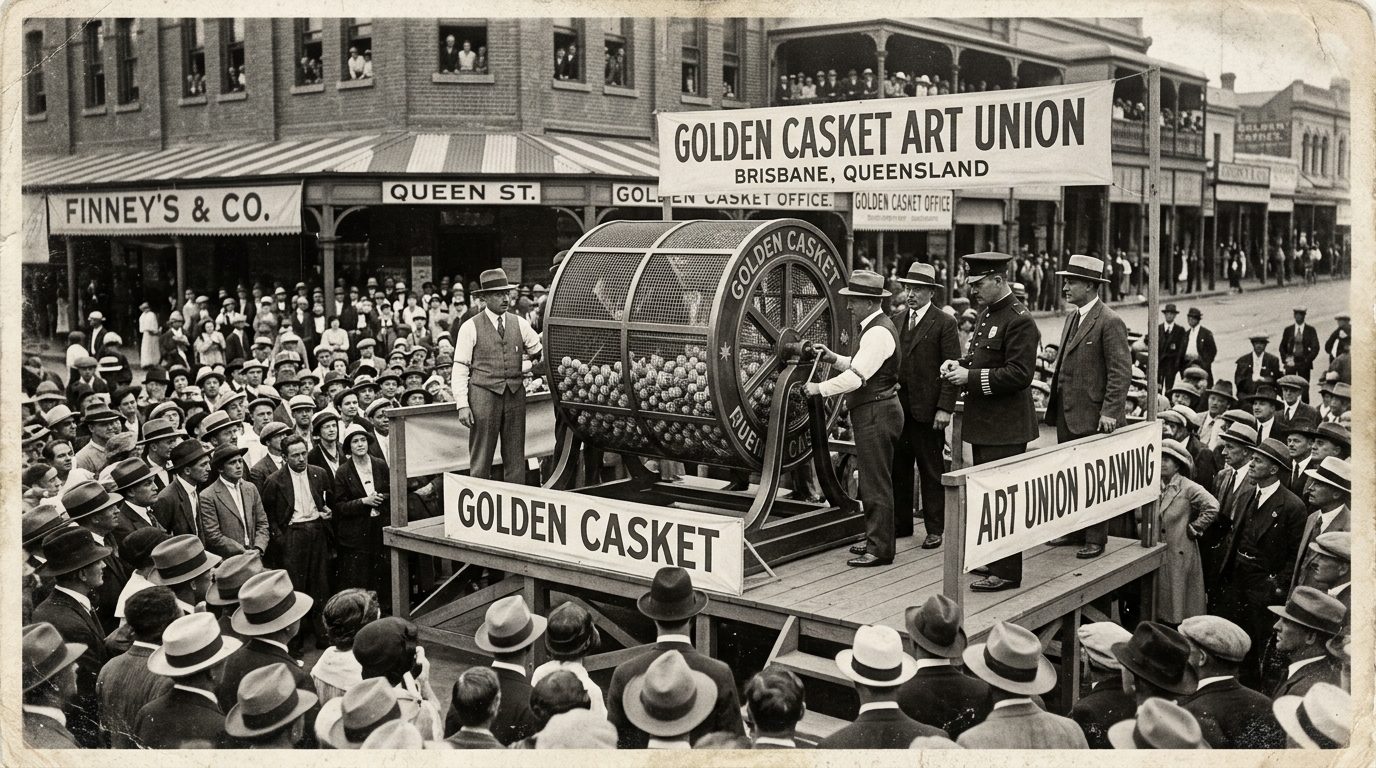
The legislative pivot from criminal prohibition to state-controlled lotteries and church-operated bingo as vehicles for public healthcare and hospital funding.
The 1906 Gaming and Betting Act and Mechanical Totalisators
At the turn of the twentieth century, Australian state parliaments responded to evangelical temperance campaigns by restricting commercial bookmaking. The landmark Gaming and Betting Act 1906 (NSW) banned off-course betting parlors and mandated that race betting occur strictly on licensed turf. A transformative technological breakthrough occurred in 1911 when Australian engineer Sir George Julius invented the world's first fully automatic, mechanical totalisator. Julius’s machine calculated changing odds instantly and transparently, drastically reducing bookmaker fraud and showing governments that wagering could be systematized.
The Golden Casket and the Principle of Social Benefit
The pivotal philosophical turning point occurred during World War I with the creation of the Golden Casket lottery in Queensland in 1916. Originally founded to support the Australian Soldiers' Repatriation Fund, the lottery proved immensely lucrative. In 1920, the Queensland Labour Government formally nationalized the Golden Casket, earmarking 100% of net proceeds for the Motherhood, Child Welfare and Hospital Fund. For the first time in the Commonwealth, gambling was legitimized not as a moral vice, but as a morally defensible fiscal mechanism to build hospitals, fund free maternity wards, and alleviate state debt.
Charity Bingo and the Erosion of Moral Opposition
Throughout the Great Depression and the Second World War, benevolent institutions, ambulance brigades, and the Catholic Church embraced weekly bingo (housie) nights. Regulators progressively enacted permits governing prize amounts and hours of play. By linking minor gaming to benevolent welfare purposes, women and the suburban middle class were drawn into regular gambling participation, firmly embedding community gaming within civic life.