
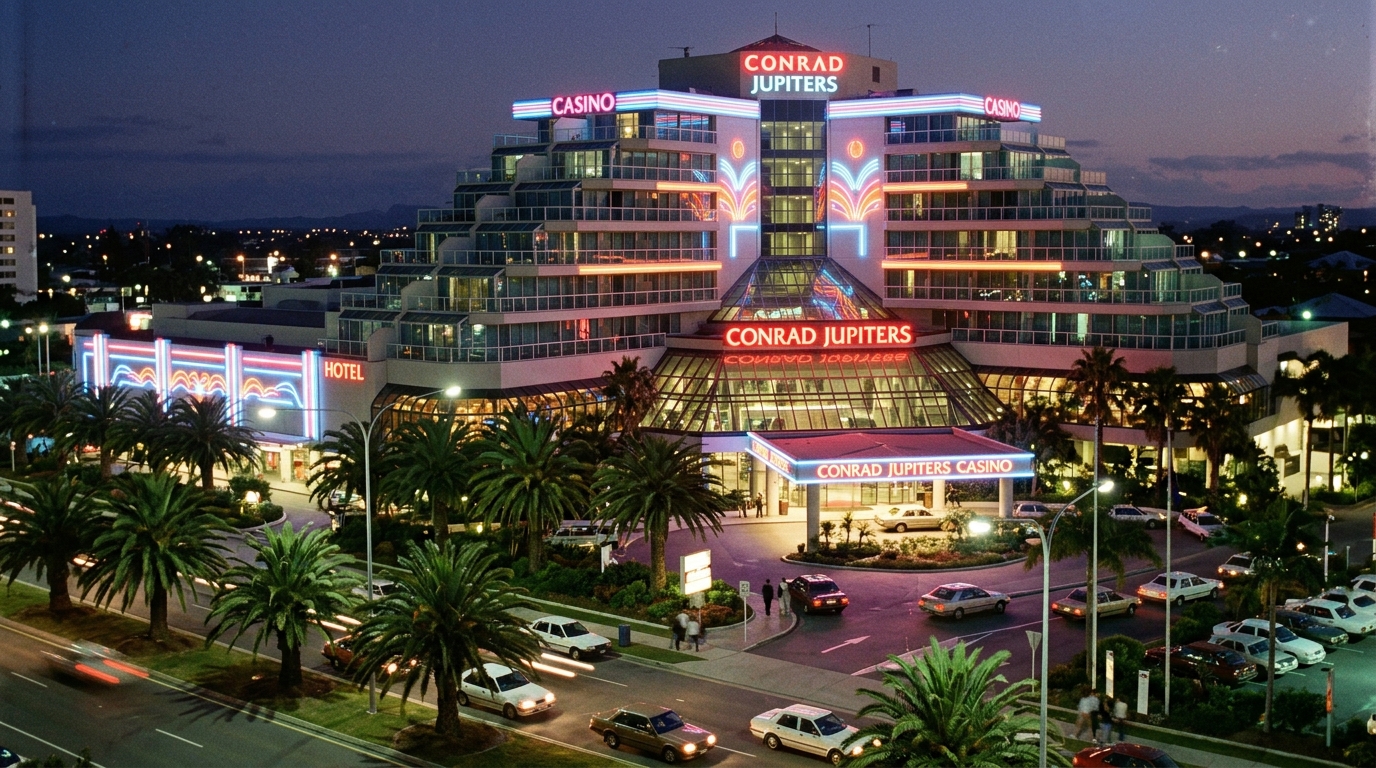
The migration of casinos from remote frontiers into bustling mainland state capitals: Jupiters Gold Coast, Burswood Perth, Adelaide Casino, and Casino Canberra.
The Paradigm Shift: From Boutique Clubs to American Showmanship
As economic rationalism swept through state treasuries during the recessions of the 1980s, Australian state governments re-evaluated their reluctance toward large-scale urban gaming. The 'Second Wave' of casino development discarded the quiet, British-inspired boutique model in favor of the vibrant, multifaceted American casino prototype pioneered on the Las Vegas Strip. Casinos were no longer quiet card rooms hidden in seaside hotels; they were integrated entertainment complexes incorporating five-star hotels, convention halls, nightclubs, and world-class retail.
Jupiters Gold Coast and Burswood Perth
In November 1985, Conrad Jupiters opened its \$210 million complex on Broadbeach Island on Queensland's Gold Coast, operated in partnership with Hilton's Conrad International. Drawing thousands of holidaymakers and local Queenslanders, Jupiters was shortly followed in December 1985 by Burswood Casino on the Swan River in Perth. Developed by Dallas Demon and Genting Highlands architects, Burswood became Western Australia's sole legal casino, complete with a massive 14,000-seat indoor entertainment dome and Japanese VIP gaming salons targeting Asian high-rollers.
Heritage Architecture: Adelaide Casino in the Railway Station
South Australia adopted an ingenious architectural approach in December 1985 by converting the grand heritage-listed ballroom and upper concourses of the historic 1928 Adelaide Railway Station on North Terrace into Adelaide Casino. The neoclassical marble columns, high vaulted ceilings, and stained-glass windows blended old-world European charm with modern gaming technology. Meanwhile, in 1992, Casino Canberra opened in the Australian Capital Territory under unique legislative conditions that explicitly banned poker machines, preserving table-game exclusivity.